Computing fields
Computable fields
Some field types are directly computable:
- abusemail – got abuse e-mail contact from whois
- asn – got from whois
- base64 – encode/decode
- cc_contact – e-mail address corresponding with the abusemail, taken from your personal contacts_cc CSV in the format
domain,cc;cc(mails delimited by a semicolon). Path to this file has to be specified inconfig.ini » contacts_cc. - country – country code from whois
- ~~csirt_contact~~ – e-mail address corresponding with country code, taken from your personal contacts_abroad CSV in the format
country,abusemail. Path to this file has to be specified inconfig.ini » contacts_abroad - external – you specify method in a custom .py file that receives the field and generates the value for you, see below
- hostname – domain from url
- incident_contact – if the IP comes from local country (specified in
config.ini » local_country) the field gets abusemail, otherwise we get country@@mail where mail is either abusemail or abroad country e-mail. When splitting by this field, convey is subsequently able to send the split files to local abuse and foreign csirt contacts. - ip – translated from url
- netname – got from whois
- prefix – got from whois
Whois module
When obtaining a WHOIS record
- We ask RDAP first – the JSON successor of the port 43 whois protocol. gTLD registries are allowed to shut whois down (ICANN Registration Data Policy, since 2025-01-28) and the RIRs are heading the same way. Should RDAP not answer (most ccTLDs, ex:
.cz, have no RDAP) or should the answer be incomplete, we fall back to whois. Choose the backend with--whois.backend auto|rdap|whois. - RDAP does not carry the announcing ASN (whois has it in the
origin:route object), hence we resolve it over DNS from the Cymru IP-to-ASN zone (needsdig; disable with--whois.asn-lookup False). - We are internally calling
whoisprogram, detecting what servers were asked. - Sometimes you encounter a funny formatted whois response. We try to mitigate such cases and re-ask another registry in well known cases.
- Since IP addresses in the same prefix share the same information we cache it to gain maximal speed while reducing whois queries.
- Sometimes you encounter an IP that gives no information but asserts its prefix includes a large portion of the address space. All IP addresses in that portion ends labeled as unknowns. At the end of the processing you are asked to redo unknowns one by one to complete missing information, flushing misleading superset from the cache.
- You may easily hit LACNIC query rate quota. In that case, we re-queue such lines to be queried after the quota is over if possible. At the end of the processing, you will get asked whether you wish to carefully and slowly reprocess the lines awaiting the quota lift.
Detectable fields
Some of the field types are possible to be auto-detected:
- ip – standard IPv4 / IPv6 addresses
- cidr – CIDR notation, ex: 127.0.0.1/32
- port_ip – IPv4 in the form 1.2.3.4.port
- any_ip – IPv4 garbled in the form
any text 1.2.3.4 any text - hostname – or FQDN; 2nd or 3rd domain name
- url – URL starting with http/https
- asn – AS Number
- base64 – text encoded with base64
- wrong_url – URL that has been deactivated by replacing certain chars, ex: "hxxp://example[.]com"
Overview of all methods
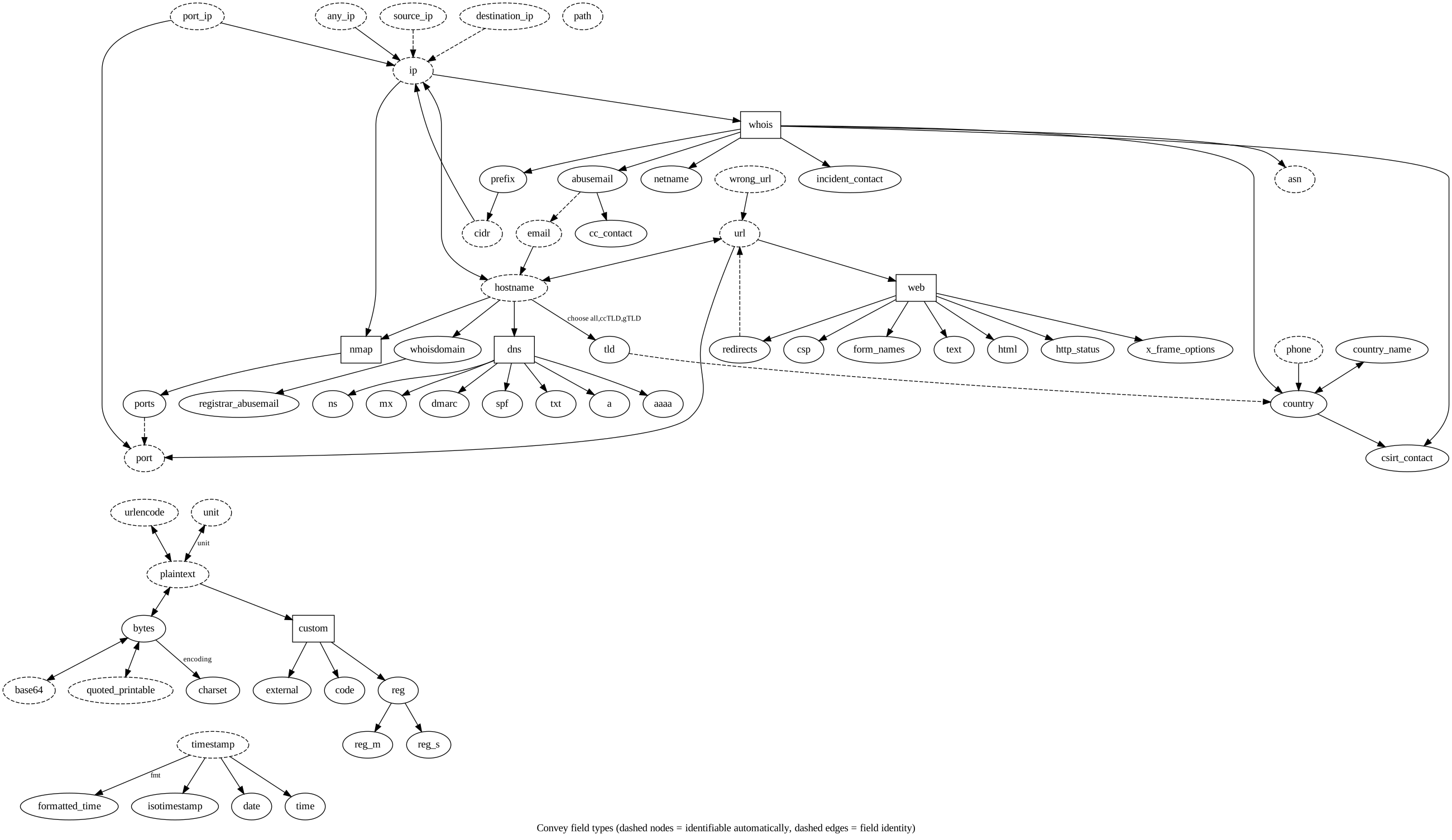
Current field computing capacity can be get from --show-uml flag. Generate yours by ex: convey --show-uml | dot -Tsvg -o /tmp/convey-methods.svg
- Dashed node: field type is auto-detectable
- Dashed edge: field types are identical
- Edge label: generating options asked at runtime
- Rectangle: field category border